Monday, November 22, 2021

The Tools and the Art of Splitology

I've spent a lot of time during the past six months learning the art of Splitology, and I'm happy with my progress. Actually, Splitology could be considered as much science as it is art which makes it all the more interesting. The neat thing is that you don't need expensive, complicated equipment. Just a few simple hand tools will do, and I find that the process (it's too much fun to call it work) is relaxing and the end product is certainly valuable. And I needed relaxing.

I am definitely showing the symptoms of political and cultural burnout. On both the local and national scene I've lost track of who is against/for what and why. I do know that history on several fronts is being rewritten, and one of those fronts is the Civil War. It saddens me to see statues of Robert E Lee...arguably one of the most noble and principled men that this country has ever produced being taken down. 

I don't understand why supposedly thousands of teachers and hospital workers are quitting their jobs, or why the 'supply chain' is busted, or why inflation is rising or why businesses are closing or scaling back because they don't have workers. I don't understand why Covid and the past Presidential election are still contentious issues, when the evidence and facts are so clear. About the only thing I'm sure of is that both political parties agree that America is broken. To fix it the Democrats are pushing their Build Back Better bill, while the Republicans wave their Make America Great Again banner. The base assumption is that before the country was broken, it was solidly united. Which is wrong. We have never been solidly united on anything, going back to the founding of the country. 

When it was decided to declare independence from England, historians estimate that between 40 and 45 percent of the white population in the Thirteen Colonies supported the Patriots' cause for independence; between 15 and 20 percent supported the Loyalists, and the remaining 35 to 45 percent were neutral or kept a low profile. The great majority of the Loyalists remained in America, while the minority went to Canada, Britain, Florida, or the West Indies. Less than half of the population were openly in favor of independence. 

No war since the revolution, no social issue, no election has ever had an overwhelming majority of supporters or detractors. Given that constant division, what has made America great is the Constitution, democratic rule and the willingness to compromise. Too many people have either forgotten or are ignoring those principals. Political and celebrity ambition takes precedence over the good of the country. Reason takes a back seat to deceit and fabrication. Anyone who is not a player in these intrigues has got to feel bewildered and beleaguered. Splitology can help to deal with the anxiety.

Splitology is the art/science of splitting a log. Mechanical log splitters are available, but they're expensive, need to be stored, and remove all the fun/creativity from the activity. The usual manual method involves swinging a hefty splitting axe. It works well if you're a younger man and your back can stand it. I've come up with a method that is safer, is less strenuous, requires creativity and is just plain fun. 

To do it my way all that is needed is a log, two or three railroad spikes, and a 16oz hammer. I get the logs from trees in my yard. Railroad spikes are easy to find. Just drive to some small town with a railroad track - most towns in my neck of the woods have railroad tracks and a 'historic railroad depot museum'. Walk the tracks for a little way and you will find more spikes laying loose than you can carry. All you have to do is drive the spike into the log until it splits. If you have a stubborn log you may need two or three spikes at different locations in the log to split it. Rather than kneeling to drive the spikes I use a stool. It is the right height and much easier on my back.
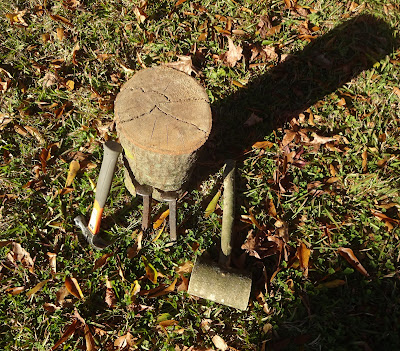
Not all logs are the same. This log has aged a bit, cracked, and clearly shows you where to place the spike. It will split cleanly into four pieces and more if desired. Others are more dense; show no sign of cracking, and require many hard blows just to get the spike started. I have even had occasions where a spike has 'jumped out' after minimum penetration. I hold the spike in my hand while hammering and can almost feel the log pushing it out - rejecting it. But stay with it and sooner or later a tiny crack will appear, and then it's game over.

If you have a lot of logs and become bored, make a game of it. What I do is imagine that the head of the spike is the head of one of my least favorite people. You would not believe how many times I have bonked the head of Nancy Pelosi, AOC, Bernie Sanders, Chuck Schumer, Elisabeth Warren, Senator Jon Ossoff, the governors of Tennessee, Georgia and Florida, and my favorite hammer blow recipient, Donald Trump. I've not bonked Marjorie Green because it's obvious that she's already had too many blows to the head.

Splitology won't cure the ills of the country or make them any more understandable but it sure makes me feel better. And I've got a wood shed full of cooking fuel. Can't beat that. 

Monday, October 4, 2021

The Other Guy

I wasn't aware of this article when I wrote my previous post. It states much more clearly what I was trying to express. The other day there was a female celebrity speaking at an abortion rights rally, I forgot her name, who said that America is more f....d up than it's ever been. I can't disagree with her. Yes, there is football and baseball and Fall festivals and theatre to give us respite from the mud slinging and name calling, but all of the media outlets continually draw us back to the political and cultural conflict in this country. 

We know who has brought us to this state of affairs. It's the other guy. It's the other guy who is wrong, evil, deceitful, and wants to take control and silence us and destroy democracy. What is so disappointing is that, as the poll from the University of Virginia’s Center for Politics confirms, we are the other guy.

 WASHINGTON POST

Our republic is gravely sick. A new poll confirms it.

Opinion by Henry Olsen  |  October 1, 2021

Many Americans are increasingly concerned that our national heritage, our democratic republic, is seriously in danger. A new poll from the University of Virginia’s Center for Politics confirms that we have reason to worry — and that the fault is in ourselves, not our political stars.

We can see the signs of the fraying bonds of citizenship all around us. The increasingly hostile tone of mainstream political speech. The inability of our two parties to find common ground in cases of clear national interest, such as raising the debt ceiling. The way that leaders of each side accuse the other of intentionally subverting the election process to ensure their hold on power. The fact that partisans increasingly isolate themselves in information bubbles where they only hear their side of an argument and often only the extreme elements of that side.

That’s why the Center for Politics poll is so worrying. It surveyed 2,000 voters on a host of issues related to democratic health, especially how each viewed members and leaders of the other party. It found that large numbers of Joe Biden and Donald Trump voters view the other party with fear and contempt.

The most frightening findings show that supermajorities of voters in each camp believe the other side is bent on destroying the country. More than 80 percent of Biden and Trump voters agree that elected officials of the other party “present a clear and present danger to American democracy.” More than 70 percent of both sets of voters believe that some extreme media voices on the other side should be censored “despite the U.S. Constitution’s First Amendment.” More than 75 percent of Biden and Trump voters believe that Americans who strongly support the opposite party also threaten the American way of life. In short, politics has stopped being about how to govern a shared country and is more about a naked, “Lord of the Flies”-style struggle for power.

It should be no surprise, then, that voters on both sides of the partisan divide are embracing views that are inconsistent with democracy. More than 60 percent of Biden voters and roughly 80 percent of Trump voters believe things like “true citizen[s]” should “help eliminate the evil that poisons our country from within” and America “needs a powerful leader to destroy the radical and immoral currents prevailing in society today.” Nearly identical shares of both sets of partisans — about 45 percent — say America would be better off if the president could take “needed actions without being constrained by the Congress or the courts.” There’s a word for a strong leader whose word is law: dictator.

Substantial numbers of Americans in each camp are even willing to break up the country. Forty-one percent of Biden voters and 52 percent of Trump voters say the “situation in America is such” that they would favor Blue or Red states “seceding from the union to form their own country.” That would surely fail if only one side wanted a separation. The dissolution of Czechoslovakia into the separate states of the Czech Republic and Slovakia in 1993, however, shows what might happen if enough people want it.

Note that this is not a case where one side holds problematic views while the other does not. Democrats and Republicans harbor hatred for members of the opposing party in nearly equal measures, and both view anti-democratic practices with nearly equal regard. This corroborates data from the Pew Research Institute, which has found that partisan animosity has risen and is widely shared by each party’s supporters.

The poll points to a frightening future, but we have resolved such moments before. We have done this peacefully, aside from the Civil War, because shrewd leaders such as Thomas Jefferson defused conflicts by persuading large numbers of the other side’s partisans to defect to new coalitions. Supermajorities of Americans supported these coalitions over many elections, establishing a new political order democratically. The new regime also did not suppress the basic rights of its adversaries, maintaining commitment to free speech, free elections and the rule of law. That political understanding and skill is why America’s experiment in self-government has endured for so long.

The cup of conflict will not pass from our lips no matter how much we pray. We will pass through this trial strong and intact only if we imitate Jefferson and are guided more by what we will build than by whom we will destroy. Our edifice must have as its cornerstone the fundamental American truth: “that all men are created equal … endowed by their Creator with certain unalienable Rights.” Only dedication to that principle will enable us to transcend our present division into warring tribes and recover the shared sense of citizenship we so sorely want and need.

Thursday, September 30, 2021

Wisdom from the Ages

Voltaire, whose real name was Francois-Marie Arouet was one of the most prolific writers of the 1700s. He used his pen to write plays, poetry, and to express his views on a host of political and social issues, some of which earned him time as a prisoner in France's infamous Bastille. My impression of Voltaire is that, though he was strongly opinionated, he had the intelligence to realize that opinions are preferences...beliefs not usually based on fact. He stated that concept most clearly when he wrote: 

"Doubt is an uncomfortable condition, but certainty is a ridiculous one.” 

Think about that. Think about that in terms of today's issues in the United States - Afghanistan, immigrants at the border, Biden's present administration, Trump's past administration, Covid masks and vaccinations, Roe vs Wade, racism, the economy, freedom of choice, etc. According to many polls roughly half of us Americans know the truth about these topics. We are absolutely certain of our positions. The truth and certainty that the other 50% of us espouse is false. And nobody knows the truth better than the Democratic far-left...and the Republican far-right. Both are passionately certain that they know the truth and will spin a topic to any extreme to prove it. 

I don't know who coined the term RINO - Republican In Name Only, but I suggest that the definition be changed to Reasonable In Name Only. A friend recently wrote to me that the present situation is not just a political war, that it is also a cultural war. I think that there is probably some truth to that viewpoint, but to me it's more than that. It's not difficult to sit back, take a macro view of the present turmoil in this country and see it for what it is...a war on reason. A war to defend one's opinions and beliefs come hell or high water, regardless of whether they can be supported by evidence. 

I don't think that it is 100% of us Americans who are actively involved in these wars on politics, culture and reason. I want to believe that there is this vast silent majority who is sitting back, shaking their heads and thinking that we should be so much better than this. 

Sunday, August 15, 2021

Back on Track

I've never really been a collector of anything. I have lots of books, and have acquired a few Civil War articles but I don't consider that as collecting, not like people who have accumulated oodles of stamps, shot glasses, Coke memorabilia or key rings. That sort of changed when I bought a pitcher and two goblets dated 1880 and engraved with the initials CC. Being 140 years old appealed to my sense of history, and I've always been fascinated with anything silver. The goblets polished up beautifully - the pitcher was a disaster so I let it go back to it's tarnished condition, which surprisingly took only a couple of months. Somewhere in this blog I wrote a post about that set so I won't go any further with that subject except to say that it did inspire me to see if collecting goblets might be a fun and interesting thing to do. 

The first thing I did was to give some thought to what I meant by goblet. The criteria I came up with was first, the goblet had to be metal and preferably silver. Engraved and jewel encrusted would be a plus, like the goblets I envisioned King Arthur and the boys swilling ale from at the round table. Secondly, the goblet must be of a certain age. In the antique world anything older than 40 years is considered vintage but that makes me vintage x 2 and I refuse to acknowledge anything made in 1981 (or 71 or 61 or 51 or 41) as old, so I settled on pre-1940. 

Armed with my requirements I started haunting antique shops in earnest. The first thing I discovered was that there are not a lot of metal goblets in antique shops. Glass yes, plastic yes, wood yes, but not metal. In my eagerness to start a collection I quickly lost my focus. Without realizing what I was doing I started purchasing any metal, silver-plated bowl shaped vessel I came across, regardless of size or intended usage. As of three months ago my collection consisted of six legitimate goblets meeting my criteria and nine other items ranging from sherbet goblets to I-don't-know-what. 


Many of my 'mistakes' have already gone to Goodwill and the remaining five in the above photo will follow them as I find real goblets to replace them. The good news is that my most recent purchase of two days ago is sitting on the shelf directly beneath the pitcher.


This is what I had in mind when I started collecting. It's not jewel encrusted but you can't have everything. Examining it in the shop there was no indication of where or when it was made or by who. Stamped on the bottom is a trademark I had never seen that appeared at first to my old eyes be Asian. I passed on it the first time I saw it, but a week later when it was still there I bought it. It took a few hour's worth of research to identify the stamp and when I did I was surprised. 


The figure on the left is the town symbol of Edinburgh, Scotland. The two middle figures are supposedly the first and last initials of the manufacturer. I have not been able to identify them so far. The same stamp on an antique website claims they represent Carrington & Co. of Edinburgh. I am not convinced. The figure on the right is a date symbol indicating the goblet was manufactured in either 1893 or 1894. I will enjoy the coming hours of trying to identify the manufacturer, but if I never do I am content knowing where and when it was made. 

It is very heavy, apparently being silver plate on steel. A little silver polish had it looking like new. For anyone interested the price was $17 plus tax.

If the predicted storms hold off I'm going to grill some burgers on the wood grill later this afternoon and accompany them with some ale from my new goblet. King Arthur would approve.


Tuesday, July 20, 2021

...the Eye of the Beholder

What I know about art, and by art I mean painting, would fit on the tip of an artist's brush. A very tiny artist's brush. Maribel and I occasionally watch the Antique Roadshow on PBS. We enjoy guessing at the prices that will be placed on some of the objects people bring to be appraised. When a painting is being evaluated we're usually not even close. In the upper echelon of the art world the artist accounts for a good percentage of a painting's worth. For us lessor beings I would guess that some combination of color, composition and content are what determines whether we like a painting or not. And that combination is different for each of us. A painting is neither good nor bad; beautiful or ugly. The painting simply is...the individual judges it based on personal taste.  

When we're strolling through an antique shop or art gallery probably 95% of the paintings don't appeal to me. They're attractive but nothing I need to own. Occasionally there are some that 'talk' to me, but not loud enough to make me reach for my wallet. And then there are those rare times when a painting will 'scream' at me...challenge me to walk out without carrying it under my arm. When that happens I continuing browsing but invariably return and end up with the painting at the check-out counter.

In 2013 Maribel and I were at Chiclayo's Cultural Center to view an art exhibition of paintings done by local artists. Upon entering one of the exhibition rooms there was a painting mounted high on the wall in a corner that immediately caught my attention. I cannot adequately explain why the painting appealed to me so strongly, and still does to this day.

The Information card gave the artist's name as Ruben Saavedra. The curator of the Cultural Center was able to give us Ruben's phone number. We called him and he agreed to meet us at a restaurant to discuss the painting. Ruben at that time was in his very early 20s, was personable and seemed to me to be exceptionally mature and intelligent. We talked about his inspiration for the painting and were surprised to learn that the female model was his mother. When we had finished eating I told Ruben I was interested in the painting and wanted to purchase it. He agreed to sell it, we settled on a price and the deal was done. As we were leaving the restaurant Ruben shook my hand and laughed, saying, "I can't believe that I just sold my mother." The next day he delivered the painting to our Chiclayo apartment.

It was about two years later that we contacted Ruben again. I was in the process of writing a memoir titled Chicken Sunday Afternoon and wanted a picture for the cover page but couldn't find what I wanted. I had a concept in my mind and met with Ruben to see if I could explain it to him, and if he understood my idea could he paint it. Ruben did some preliminary sketches and invited us to his house to look at them. It was at that time that we met Ruben's mother, Señora Juana Cobeñas, and the four of us took turns voicing suggestions about what the final painting should look like. It would take too long to explain in detail what the painting was supposed to represent and how it got its name. It is sufficient to say that the concept is that 10 year old Tom is sitting on the curb in front of his house on a Sunday afternoon, not thinking at all of the future beyond tomorrow, and 80 year old Tom is looking at the boy, knowing and reflecting on what the coming years have in store for him. A few days later in Ruben's studio in Tumán, Peru, the painting titled Chicken Sunday Afternoon came into being.

That painting joined Señora Juana Cobeñas in our living room, and did become the photo on the cover page of my memoir.

When we returned to the US in July of 2017 there was no thought of taking the paintings with us, and on subsequent trips there wasn't the room to take them. On her recent visit Maribel removed the canvas paintings from the frames, carefully rolled them and placed them in a suitcase. They arrived in Georgia perfectly intact. I used some 1"x2" furring strips to make new stretching frames and chose standard staples to attach the paintings to the frames. Now both Señora Juana Cobeñas and Chicken Sunday Afternoon are once again on display.  And while we like the paintings, it is really the paintings, the people, the circumstances, the times and the resultant memories that combine to give us so much enjoyment. 

We are still in touch with Ruben. He is a prolific artist, displaying his work nationally and internationally, and I presume is doing well for himself. His Facebook page shows that he has broadened his style and choice of subject matter. 


This is a fairly recent photo of Ruben and his family. His mother is easily recognized as Señora Juana Cobeñas in our painting. Sadly, Ruben's father Adrián died this last April 12th. Our sympathies go out to the family, as well as our wish for Ruben's continued success in the art world.


Friday, July 16, 2021

Fish Fry Friday...Then and Now

In the upper Midwest, at least in Wisconsin, Friday means fish fry. I'm fairly sure that the tradition dates back to the old Catholic Church prohibition against eating meat on Friday. In the old days there were mom-and-pop fish markets everywhere, and housewives could be seen coming and going Friday morning with their meticulously selected fish in their shopping bags. Whitefish and perch were the most popular. Grouper and halibut were thought to be more favorable but were too expensive for the average household. But to do the tradition right, to actually celebrate Fish Fry Friday, and it was a mini-celebration of sorts, you had to do it in a tavern. 

Many taverns offered fish on Friday and because there were so many taverns the customers were usually locals and knew each other, so it became a social event, like a club meeting every Friday. Swinko's was a corner tavern located directly across the street from our house on Milwaukee's south side. I distinctly remember customers including my father proudly proclaiming that "nobody served better fish or beer and at a fairer price than Tony Swinko".  The preferred place to eat your fish was at the bar for ease of conversation purposes, but we always went as a family and state law prohibited kids from sitting at the bar (I was 10, my sister 6) so we ate at a table but were still able to be included in conversations. That was a long time ago. The last time I was in that neighborhood was over ten years ago, and it will be my last visit. Swinko's is now a dilapidated apartment complex, Lindner's grocery store on the corner across from Swinko's is a private house and the entire neighborhood is a Hispanic barrio in badly deteriorating condition.

Here in North West Georgia there is a pseudo Fish Fry Friday. There are no taverns. Most restaurants offer fish and some as a Friday special. One issue I have is that many restaurants serve only catfish. We like catfish but don't prefer it. Often it has a musky, muddy taste to it. Our preference is cod or halibut but they're hard to find. There are a few sport's bars but I don't know if they offer fish, and they're a far cry from the neighborhood tavern I'm talking about, as pictured above. Seems like these days everybody's into Wings with a plethora of sauces ranging from mild to scorch your larynx. 

Maribel and I will be going out for fish later this afternoon. What prompted this post is that in the shower this morning I asked myself, "Why?...why are we going out for fish?" I asked Maribel that question and she answered that part of the reason is to mark the end of the week (though weekends are really meaningless for us as every day is the same), and because she didn't have to cook. We both agreed that none of the restaurants we're familiar with have a unique or particularly pleasing ambience. And some of the restaurants have better fish than others, but none are better than the fish Maribel cooks at home. Mostly what's going to be missing today is the social experience. When we go to a restaurant with friends it's a whole different ballgame. There's conversation, there's life, and the establishment itself seems to take on a more lively, friendly, interactive atmosphere. It's not a neighborhood tavern, and you don't know anybody other than the people you're with, but it does sorta kinda bring back memories of the Fish Fry Friday 'Swinko's Tavern' experience. 

I know that I can't go back to those days, and I don't know for sure that Milwaukee taverns still serve fish fry's. In fact I'm not even sure that corner taverns exists anymore. I hope so. I'd hate to think that the Swinko's era has passed. 

Sunday, July 11, 2021

Un Dia Perdido

Today is going to be a lost day - un dia perdido. Storms are forecasted with strong winds. My project list during Maribel's absence is pretty well completed. Plus it's Sunday. I never liked Sundays, even as a kid. Sunday was a visit-grandpa-and-grandma day. And I had to wear my best clothes which carried with it the caution from mother that, "...and don't you get those clothes dirty or I'll tell your father!" And the other kids were doing Sunday family stuff like visiting grandpa and grandma, going to the zoo, taking a ride in the country or having a picnic in a park so there was nobody to play with and nothing to do. It was in those early days that I discovered the value of a sanctuary - a place where I could relax, read, or just feel good and think about things. As a little kid I shared a bedroom with my sister so the front porch was my sanctuary. Later I had my own room and that was my first real sanctuary where I could enjoy my privacy and also shut out the trials and tribulations of being a teenager. 

For the next 40 years, living at many different addresses I didn't have a sanctuary; didn't really even think about it. Wherever I was I always had a favorite chair for reading or listening to music but that's not the same thing. Later, when everything in my life went south; when I threw up my hands in surrender and said screw it, I bought a place in Wisconsin's north woods. It had what the previous owner called a sun room. I've always been a history buff and particularly medieval history, and I could see the potential for a medieval sanctuary in that sun room. It didn't take me long to build a medieval chest, table and lamp, and to locate medieval wall hangings and drapes. At night I'd light candles, listen to new age music and let the peaceful feeling of Camelot wash over me. I loved that room.


Fast forward to Chiclayo, Peru. We built a second floor apartment and off of what we designated as the office area was a small triangular space that we weren't sure what to do with. We thought about adding a door and using it for storage but it seemed like it had more potential than just a storage room. That's when  the thought of a sanctuary took shape. Maribel, Brian and me lived in the apartment and sometimes one of us or all of us would sit in what we called El Bistro watching the movement on the street with only candles for illumination. I spent hours stringing beads to make the room divider. It was a great place to eat lunch during the day and to watch the world go by at night.


On to the present. We decorated our home in northern Georgia pretty much as we wanted it. There was a room off of the kitchen-dining area that except for a filing cabinet was empty. That changed when we purchased a humongous Queen Anne dining set. It forced us to rearrange the living room, kitchen-dining area, and to utilize the empty room. Our old kitchen set had to go in it, which dictated that we do something to complete the room, and that was when the idea of El Bistro II arose. We had to buy a few things but mostly it was just a matter of relocating items we already had. To top it off and maintain the El Bistro tradition, Maribel strung beads for the doorway. 


Yesterday I also said that it was going to be un dia perdido, but that changed when I went to get the mail and upon opening the box had it fall into my hands. The wood base attaching the mail box to the metal pole had rotted and crumbled. I didn't have the right size board so had to splice and join some pieces to make one. Then it had to be painted and while it was drying I went to Home Depot for machine screws, nuts and lock washers. All of this while working in between isolated thunderstorms so the project took me most of the day.

I am determined that today will be a lost day. Unless I remember something I should do or something else comes up. But until/unless that happens, I intend to spend a good part of the day where I am right now...sitting in front of that lap top in El Bistro II.